
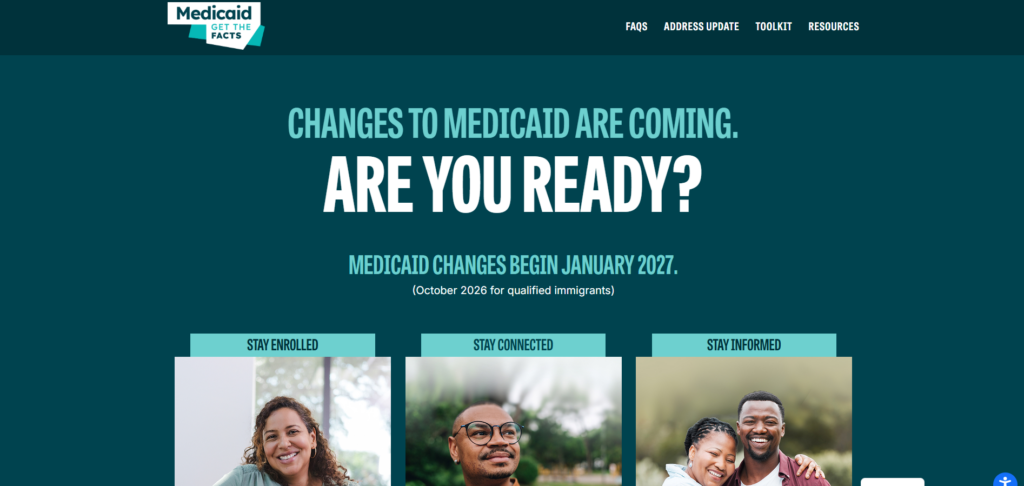
An estimated 400,000 individuals in Illinois could lose their health coverage due to federal Medicaid cuts that start in October 2026.
Cook County Health’s Medicaid Impact Workgroup today announced the launch of Get Medicaid Facts, a microsite y communications toolkit designed to help enrollees, community organizations, health care providers, insurers and public agencies prepare for major upcoming changes to Medicaid eligibility.
In 2025, federal lawmakers passed House Resolution (H.R.) 1, also known as the “One Big Beautiful Bill Act.” Key provisions of the legislation are projected to cut $1 trillion from Medicaid nationally over the next 10 years, including $26 billion in cuts to Medicaid funds for Illinois. An estimated 400,000 Illinoisans could lose coverage due to funding and eligibility changes contained in H.R. 1, according to Robert Wood Johnson Foundation.
“The health care provisions of H.R. 1 will bring widespread and complex shifts to the Medicaid program in the years to come, including more requirements customers must meet to be eligible for coverage and major financing changes that will put significant pressure on the state budget,” Illinois Department of Healthcare and Family Services Director Elizabeth M. Whitehorn said. “Mitigating the anticipated harm these federal changes will cause by helping customers navigate the new requirements to keep their coverage and working to ensure the Illinois Medicaid program can continue to cover as many critical healthcare services as possible are HFS’ top priorities. We are grateful to Cook County Health and to all of our partners who share these goals and commitment to Medicaid customers.”
Federal guidance on exemptions and verification processes for work requirements is expected in June 2026. States are required to share details about these requirements with impacted Medicaid enrollees by the end of September 2026, with the changes taking effect in January 2027. The Illinois Department of Healthcare and Family Services (HFS) manages the state Medicaid program and is currently developing internal systems to comply with these new requirements.
“H.R. 1 imposes more complex processes that demand significant funding, staffing and infrastructure yet provides local Medicaid agencies only months to prepare,” Cook County Board President Toni Preckwinkle said. “As we have seen in other states that implemented work requirements, these policies do not improve access. Instead, they create unnecessary red tape that makes it harder for eligible individuals to enroll and stay covered, which will ultimately leave hundreds of thousands uninsured. I am proud that Cook County is collaborating with the State of Illinois to protect health coverage for as many residents as possible.”
In September 2025, Cook County Health convened the first meeting of the Medicaid Impact Workgroup, comprised of representatives from state and local agencies, health care and social service providers, insurers, businesses, academia and community organizations. The workgroup’s singular goal is to help eligible individuals in Cook County keep their Medicaid coverage despite federal cuts and policy changes.
“Cook County Health created the Medicaid Impact Workgroup because we recognize that the scale and complexity of these federal changes demand a coordinated response,” said Dr. Erik Mikaitis, Chief Executive Officer, Cook County Health. “No single organization can meet this moment alone. By aligning our efforts, we can make the biggest impact in helping patients and community partners alike navigate these complex changes.”
Public education and communications were identified as key priorities for the workgroup. The Get Medicaid Facts microsite and communications toolkit provide currently available details about Medicaid eligibility changes and provides enrollees with steps they can take to stay informed and connected for reliable, timely updates.
“Confusion about upcoming Medicaid changes is already leading people to lose coverage they are still eligible for, and that is a problem we can act on right now,” said Alexandra Normington, Chief Communications and Marketing Officer, Cook County Health. “Get Medicaid Facts resources are designed to give people clear, practical steps they can take right now, and to also equip community partners with consistent, accurate information. The more we can educate enrollees early and in a united way, the more people we can keep covered.”
La Get Medicaid Facts toolkit includes a frequently asked questions document and social media assets in English, Spanish and several other languages. These materials are available to all organizations who want to spread the word about upcoming changes and what steps enrollees can take to keep their coverage.
Recognizing the importance of sharing clear, accurate information from dependable organizations, these materials are intentionally unbranded and designed for easy customization, allowing partners to deliver messages through familiar, reliable channels that reinforce credibility and strengthen community trust during this time of transition.
The Cook County Health Medicaid Impact Workgroup includes representatives from Illinois Department of Healthcare and Family Services, Chicago Department of Public Health, CountyCare, Cook County Department of Public Health, Erie Family Health Centers, Greater Chicago Food Depository, Illinois Association of Free & Charitable Clinics, Illinois Chapter of the American Academy of Pediatrics, Illinois Hospital Association, NAMI Chicago, UI Health and more.
For more information or to join, Haga clic aquí.
MEDICAID ELIGIBILITY CHANGES
What is changing and when?
| Eligibility for “Qualified Immigrants” The federal definition of “qualified immigrants” will soon change to exclude many previously eligible, lawfully present non-citizens from Medicaid coverage. | Effective October 2026 These adult groups will no longer qualify: · Refugees and asylum seekers · Victims of domestic violence and trafficking These groups will still qualify: · Children under 19 · Pregnant people · Green card holders, living in the US for 5+ years · Cuban and Haitian immigrants · Compact of Free Association (COFA) migrants |
| Work Requirements & Increased Renewals (Redetermination) Individuals who qualify for health coverage thanks to Medicaid expansion under the Affordable Care Act (also known as “ACA adults”) will be subject to new eligibility requirements. “ACA adults” enrollees are defined as: · Individuals ages 19-64 · Have no dependent children age 13 or younger living with them | Effective January 2027 To maintain eligibility, “ACA adult” Medicaid enrollees must: · Renew coverage every 6 months (also known as going through redetermination) · Demonstrate 80 hours per month of work, school, or volunteering Some individuals may be eligible for exemptions. Details coming from HFS in September 2026. |
Do you have Medicaid? Here’s what you can do now:
| 1. Stay enrolled. The first eligibility changes don’t take effect until October. Renew your coverage and get the care you need now. 2. Stay connected. Keep your address and phone number up to date with the Illinois Department of Healthcare and Family Services (HFS). HFS will tell you if you have to do something new to keep your Medicaid. 3. Stay informed. Be on the lookout for information on Medicaid changes from HFS, your health plan and doctor’s office. Follow them on social media and sign up for newsletters. Visit GetMedicaidFacts.com for more information. |